by Howie Mooney
When we think of the 1970s, a number of standard images may pop into our minds. Some may think of thumping disco music. Some may look back on the collective angst that Watergate brought to America. Others might recall how the Vietnam war lingered and clung to our national news cycles until ‘Peace with Honor’ came in April of 1975. And others may think back to the days of inflation, a stagnant economy, an oil crisis, massive numbers of airplane hijackings and interest rates driving through the ceiling.
The rich, young and beautiful would congregate at the discos. Places like Studio 54 and CBGB’s in New York became a couple of the most famous hot spots anywhere. At the time, cocaine seemed to be the drug of choice for those who attended these places. In fact, cocaine was prevalent among all those who could afford it. It’s use became so popular in some sporting circles that Art Rust, Jr., a pioneer in the world of sports talk radio, once said that “If cocaine were helium, the NBA would float away.”
Rust was a commentator, author and sports historian. His comment didn’t really tell anyone anything they didn’t already know, but it may have opened some eyes to what some may have viewed as a persistent problem in the game. It took until 1983 though for the league and the players’ association to come to a collectively bargained agreement on installing points regarding use of the drug by members of the league.
The state of the league was in a bit of flux in the late 1960s to the mid-1970s. But to be fair, almost every sports league was experiencing the pains of growth and established leagues seemed to all be attempting to fend off new rival upstart groups. In football, the National Football League and American Football League settled their differences and learned to co-exist by merging at the end of the ‘60’s. On ice, the World Hockey Association came into being in 1972 and threatened the established National Hockey League. By 1978, the new league had played its way out of solvency and four of their clubs joined the old league.
In basketball, the American Basketball Association had begun play in 1967. By 1976, that league was finished. Merger talks between the two began in 1970. But a lawsuit filed by the NBA Players Association delayed any plans for amalgamation. When the ABA dissolved, four teams – the Indiana Pacers, the Denver Nuggets, the San Antonio Spurs and the New York Nets – joined the old establishment.
Today, we’ll step into the Wayback Machine and take a look at three personalities in basketball in 1975 and into the 1980s.
In the 1974-75 season, there were eighteen teams in the National Basketball Association. There were four divisions. At the end of the 1973-74 season, the Boston Celtics, Capital (Washington) Bullets, Milwaukee Bucks and Los Angeles Lakers finished at the tops of their divisions. The final series went seven games with the Celtics defeating the Bucks.
In the fall of 1974, heading into the season, the Atlantic Division was expected to be headed by either the Celtics or the Buffalo Braves. Washington was called by experts to take the Central. Milwaukee was predicted to win the Midwest, and the Lakers were called to take the Pacific again.
In this new season, there were going to be ten teams in the postseason instead of the eight that made it previous year. There would be a kind of a play-in best-of-three series for the fourth and fifth place teams in each conference. Anyway, the Celtics did take the Atlantic Division and Washington finished at the top of the East. But over in the Western Conference, Milwaukee won the Midwest, but the Lakers finished last in the Pacific. Golden State surprised everyone by winning 48 games in that division and finishing in first place.
The play-in series were best-of-three and in the East, the Houston Rockets knocked off the surprising New York Knicks in three games. It took the Seattle SuperSonics three matches to edge out the Detroit Pistons over in the West. Both of those winning teams would be eliminated in the semi-finals though. The Boston Celtics took the series against Houston in five. It took six games for Golden State to defeat Seattle. Washington went the full seven in beating the Buffalo Braves and the Chicago Bulls beat KC-Omaha in six.
That set up the conference finals. It was Washington and Boston in the East and Golden State and Chicago in the West. The West final went seven games, and the Warriors came out on top. In the East, the Celtics fell to the Bullets in six. The league final series took four games in six days to complete. Golden State swept Washington.
The final game took place on May 25, 1975. Four days later, on May 29, a Thursday, the National Basketball Association draft selection took place in New York. There were a couple of little wrinkles that took place before the draft. Between the end of the last finals game and selection day, the Kansas City-Omaha Kings got a new venue, the Kemper Arena, and they changed their name to just the Kansas City Kings.
Secondly, this was the first draft that would allow eighteen collegiate underclassmen and two high school players to be eligible. The other thing that could have been perceived as odd at the time…the first two picks were reserved for the teams in each conference who placed last in the standings. They would have been the Lakers and the New Orleans Jazz. There would be a coin flip to determine which of those teams would select first.
The Jazz won the coin toss. But they didn’t control their first pick. That had been dealt in a package to the Atlanta Hawks in an earlier 1974 trade for “Pistol Pete” Maravich. So, Atlanta controlled the first overall draft choice. They also had the third pick as well, with the Lakers holding the second selection. Also, keep in mind that the elephant in the room, the ABA, would hold their draft a few weeks after the NBA and they would ultimately throw a wrench into the entire basketball landscape.
Welcome to 1975.
Getting through college and being eligible for the draft is nice, but there are no sure things. Overall, there were ten rounds in the NBA pick-fest. 174 players were chosen by the eighteen teams. 53 of them managed to play games in the league. One man from this day would make it into the Hall of Fame in Springfield. We will talk about him today. We’ll also discuss a couple of other players who achieved some notoriety through their careers, or at least enough to make us remember them more than fifty years later.
*
The Man Who Would Become ‘Skywalker’
The Hawks had the first overall pick in the 1975 NBA Draft and with that, they took David Thompson out of North Carolina State. Thompson knew that he was a very wanted commodity – in fact, the Associated Press asserted that Thompson and Morgan State’s Marvin Webster were “the most coveted players in collegiate basketball during the 1974-75 season” – and he also knew that he wouldn’t be making any decisions about whether or not he would sign with any NBA team until the ABA Draft took place in mid-June. Compounding Atlanta’s angst was the fact that they also had the third pick and took Webster. Both men would begin to play the waiting game to see what would happen over in the ABA in a few weeks.
In the Macon News, the day after the NBA Draft, there was a picture of a smiling Thompson. In his hands, he was holding league guides from both the National Basketball Association and the rival league. Without even reading the article about his selection, and just seeing the photo, one could get the feeling that Thompson would absolutely be waiting to see who picked him in the ABA draft and what they would have to offer him in a contract. The same could be deduced for Webster as well.
The ABA selection process in 1975 was somewhat convoluted. You know already that the 1970s seemed to come with a lot of strange personnel rules regarding sports. The ABA was no exception. Because they were the upstart league and because they had wanted to get the jump on the established NBA, there were rules that allowed some teams to take underclassmen if they wanted to. Thompson had already been drafted by the Virginia Squires in 1973, even though he stayed in school.
Also, any team that lost one of their stars to other teams or other leagues were awarded a bonus pick that took place exclusive of the actual draft. In 1975, the Denver Nuggets had one of these bonus picks after they lost Marvin Barnes to the Carolina Cougars. The Cougars would later become the Spirits of St. Louis by 1975. The Nuggets used their bonus selection to take Marvin Webster. Yes, the same Webster selected by the Atlanta Hawks only a few weeks earlier.
To add insult to the Hawks’ injury, the Nuggets also held the first pick overall and guess who they took. If you thought David Thompson, you would be correct. And as would eventually happen, both Webster and Thompson would sign with the Nuggets for the 1975-76 season. Oh, and the Hawks’ second round pick, highschooler Bill Willoughby, was also selected by the Nuggets. He also signed in Denver. Not being able to sign any of their first three draftees set the Hawks back. They ended up winning just 29 of 82 games in 1975-76.
Over in the ABA, the Nuggets excelled! Well, they finished atop the standings at the end of the wild year. The league started off with nine teams and finished with seven. Two teams folded within the first month – the San Diego Sails and the Utah Stars. Of the seven teams who limped across the finish line, the Nuggets finished in first place with 60 wins in 84 games. Thompson was the league’s Rookie of the Year. The New York Nets, who finished second with 55 wins, won the championship though.
The NBA first-year player who would end up making the greatest impact of all the newly drafted athletes was Alvan Adams who was taken fourth overall by the Phoenix Suns. He was named the league’s best rookie. The Suns would make it to the league’s final series but would be defeated by the dynastic Boston Celtics. The player judged to be the league’s most valuable was the great Laker, Kareem Abdul-Jabbar.
When Adams received his award as the league’s best rookie, he made his requisite acceptance speech. “I’d like to thank my teammates and coaches, and most of all, I’d like to thank David Thompson for going to the ABA.” Thompson was looking forward to having the two leagues merge. “There are a lot of outstanding players in the ABA people haven’t seen on TV – like Dr. J, Billy Knight and Artis Gilmore.” People would also be able to get a good look at Thompson as well.
The following season, the leagues merged with four of the ABA teams moving over to the older loop. Webster and Thompson’s Nuggets, the Indiana Pacers, the San Antonio Spurs and the New York Nets joined the old boys’ club. The NBA grew to 22 teams. Twelve teams would make the playoffs with the first-place clubs in each of the four divisions receiving byes to the second round. In the final series, the Portland Trail Blazers with Bill Walton took the Philadelphia 76ers (with a couple of rookies we’ll discuss a little later in Darryl Dawkins and Lloyd Bernard “World B.” Free) down in six games.
Webster, at 7’1”, established himself as one of the preeminent shot blockers in the game and he played two seasons in Denver. After the 1976-77 season, he was traded by Denver with Paul Silas and Willie Wise to the Seattle SuperSonics for Tom Burleson, Bob Wilkerson and a draft pick. The following offseason, he signed as a free agent with the New York Knicks and lasted six years in the Big Apple.
In October of 1984, he was diagnosed with an acute form of hepatitis and anemia. At that time, it was reported that he would be unable to play for an “undetermined amount of time”. He would miss all of the 1984-85 and 1985-86 seasons. In January of 1987, he signed the first of two ten-day contracts with the Milwaukee Bucks. By the end of February, he had signed with the team for the rest of the season. That campaign was the last of his NBA career.
For Thompson, playing with all the best players turned out to be a continuation on a line toward greatness. In his rookie year in the ABA, along with the league’s best first-year player, he came second in the voting for the league’s Most Valuable Player. In his second year as a pro and his first in the NBA, he earned more votes but did not win the MVP. He would do the same in his third year, coming third, and in his fourth year, finishing eighth. He was a league all-star in each of those years.
In 1979-80, his fifth year in the league, Thompson was limited to just 39 games, and his per-game production fell due to an injured foot. In the summer of 1980, the Nuggets approached him to take a cut in pay and Thompson agreed. Reports of the pay cut came after Thompson had written a letter to the team’s season ticket holders apologizing for his performance and asserting that he would play much better in 1980-81.
His play that next season was better and approached his numbers from his all-star campaigns. He appeared in 77 Denver contests and averaged 25.5 points per game, hitting on more than 50 percent of his field goals again. But 1981-82 was not good to Thompson. His per-game production fell to just 14.9 points and his field goal percentage fell as well. In June, the Nuggets traded the 27-year-old to Seattle for Bill Hanzlik and their first-round pick, 19th overall.
Lenny Wilkens was the Sonics’ coach, and he was a happy guy upon hearing the news. “I have always been a David Thompson fan. I was interested in him two years ago and one year ago as well. With the 19th pick in the draft, I don’t think we could get a player with his abilities. He will give a big dimension to our ball club. He will be another quality guard to go with Gus Williams.”
Thompson justified Wilkens’ love by playing 75 games and becoming an all-star again for the first time in four seasons. In 1983-84 though, he appeared in just 19 matches and though his field goal percentage went up, he averaged just 12.6 points per game. He was 29 years old and his career was over. The man who was dubbed ‘Skywalker’ by his teammates, for his 44-inch vertical leap, was finished playing in the NBA.
But there were nights and there were stories that would be told of numerous and various moments in his career. Like April 9, 1978, when Thompson set his sights on the league scoring title. In the team’s last game of the season at the Cobo Arena in Detroit against the Pistons, the teams went off for a total of 276 points. The Pistons won 139-137. But Thompson stepped up with 73 points in the game. But later the same day, the San Antonio Spurs went into New Orleans and George Gervin, the “Ice Man”, scored 63 to pass Thompson in a 153-132 loss and salvage the scoring lead.
Then there was the night in March of 1984 when, after a game against the Nets over at Brendan Byrne Arena in New Jersey, Thompson and some teammates headed into New York and were at Studio 54 when, according to a United Press International story, there was a scuffle and the 6’4” guard was sucker-punched and shoved down a stairway by an employee of the disco. He tore up the ligaments in his knee and had to undergo surgery to repair the joint. That combined with the lingering effects from his foot injury all contributed to the premature end to his playing career.
His issues with cocaine were documented as well. Thompson’s use of the drug allegedly began when he first injured his foot in 1979-80 but they remained private until after his first season in Seattle. When that happened, he checked into a rehab clinic in Denver in 1983. He expressed some remorse for it all. “I feel bad about Lenny Wilkens believing in me and then letting him down. I think I’ve told him that indirectly, but I guess I’ll do it formally when I get the chance. He went out on a limb for me, and I’d like to rectify it.”
In 1985, he arranged a tryout with the Indiana Pacers, but it turned out to be unsuccessful. After that, Thompson went out and consoled himself with all the alcohol and cocaine he could handle. He was arrested for public intoxication. By 1986, his coke habit was reportedly at $1,000 per day. In 1987, he incurred a 180-day sentence for assaulting his wife. It was then that he got himself clean and became a Christian.
In 1996, Thompson became the only player from the 1975 draft inducted into the Basketball Hall of Fame. Eventually, he returned to North Carolina State and in 2003, he completed his degree in sociology. In 2004, he organized and shot an autobiographical film entitled Skywalker. In 2009, when Michael Jordan was immortalized in the Hall of Fame, Thompson was there to introduce him. He then worked with the Charlotte Hornets and Denver Nuggets as an ambassador and a motivational speaker.
*
The Thunderous ‘Doctor Dunk’
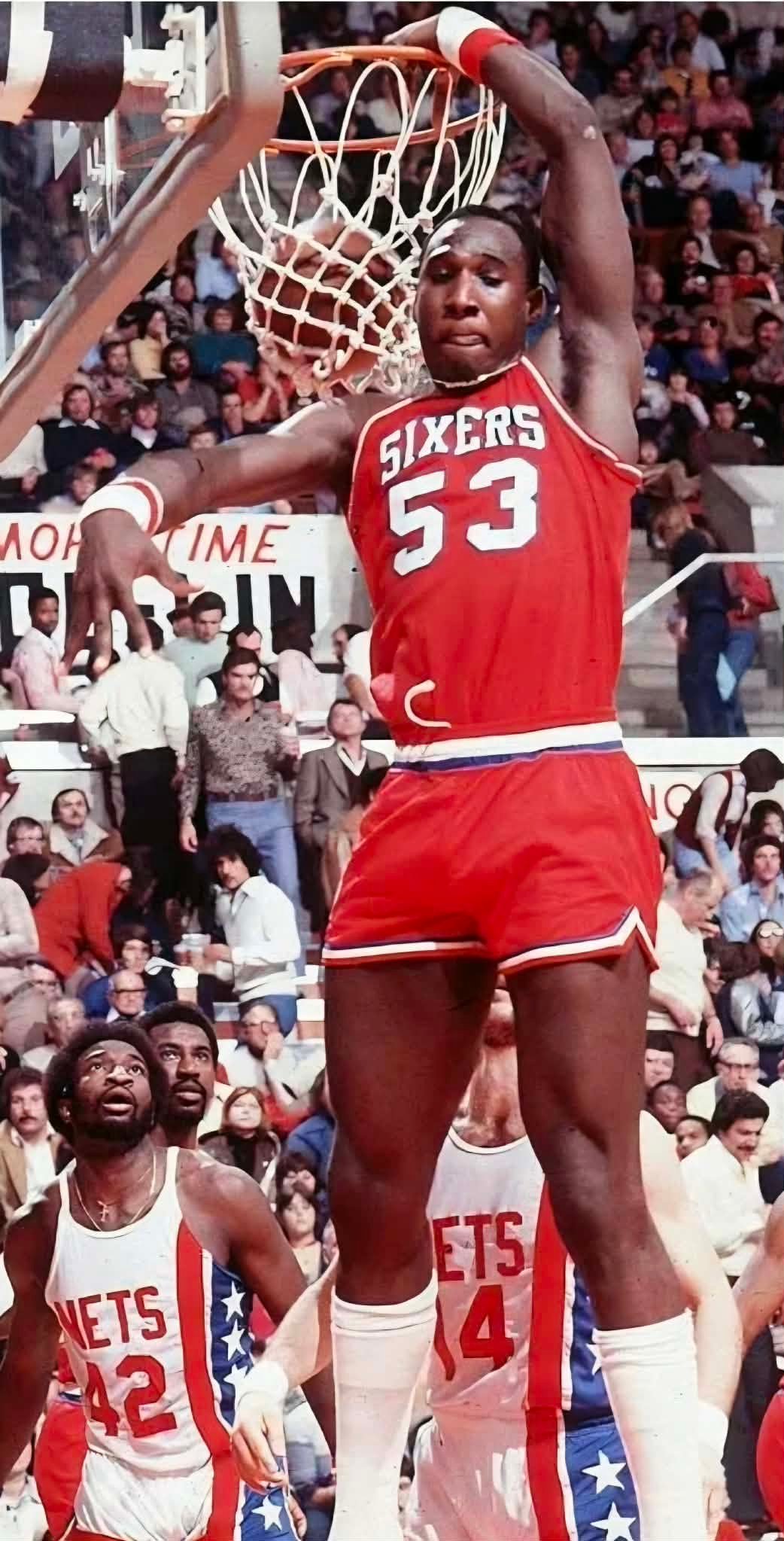
The fifth selection in that 1975 NBA draft was a guy who achieved incredible notoriety for the way he played the game and for his propensity to destroy backboards. Back on that May Thursday, the Philadelphia 76ers took a 6’11” center from Maynard Evans High School in Orlando, Florida. Darryl Dawkins, who would later become recognized as “Chocolate Thunder”, “Dawk” or “Doctor Dunk” among many other nicknames, led his school team to a 32-2 record and a state title and would become well known across North America for the intensity with which he played the game.
As a high schooler, he had captured a lot of attention, but people were skeptical of what he might accomplish at higher levels. Jack McMahon was a 76ers’ assistant coach. He flew into Orlando and didn’t know really where he should go when he got there. “I called one of the papers, asked who the best player in town was, and where was the game. I don’t think they knew who I was, but they had to guess I was a scout.”
“I hadn’t seen a high school game in five years, so I went out early and by this point in the season, I’m skeptical to begin with. I’m already turned off by the length of the season, the number of games and the lack of exciting players. There hadn’t been a Marvin Barnes to watch.” McMahon’s demeanour changed when the Evans High kids came out for their warmups.
“They come out, there’s no question which one Dawkins is, and I say, ‘He can’t be 18. This guy’s gotta be 30’. I mean if somebody says to me, ‘The guy’s 25’, I’d say, ‘Ya’.” But there was one play in particular that caught McMahon’s eye. “The other club went to a zone, moved the weakside guard out to help, had the centre come out. Immediately, he’s hitting the open guy in the corner. Some of the guys in our league today couldn’t find the guy on a bet.”
The 76ers coach then was Gene Shue. The general manager was Pat Williams. They had each seen Dawkins once. McMahon watched him three times. McMahon explained his thoughts. “I kept projecting where we were picking, what we needed and who was out there. Gene always asks me, over and over, does the player have potential? Is there potential for greatness? I looked down the list. I saw David Thompson way above everybody. Then I saw some good people who could become great. Lionel Hollins, Rich Kelley, a couple others. After that, I saw question marks. I came back and said Darryl Dawkins had the potential to be great.”
Gene Shue liked what he heard and when Dawkins was still available at the 5-spot, Williams took him. The day after the draft, Dawkins began to make his way to Philadelphia. He was travelling with his mother Harriet, his Evans High coach, Fred Pennington and his minister, the Reverend W. T. Judge.
There was a man who wasn’t heading up to Philly, but whose opinion mattered to Dawkins. “I think the most influential person was Charley Caperville, my bossman down at the tire service where I work,” Dawkins told the Philadelphia Daily News. “He told me to do what I thought was right. I think this is right.”
Williams wouldn’t divulge any concrete contract numbers, but it was expected that Dawkins would sign with the Sixers for seven years for about $1 million total and yearly six-figure bonuses. “We’ve got an agreement,” Williams told the Daily News. “We don’t have a contract drawn up, but we’ve had an understanding for a few weeks. And we didn’t steal him, either. It’s pretty lucrative.”
For Dawkins’ part, he was stoked. “I’m super excited…the biggest thrill of my life. But I’m not gonna let it change me. I’m still gonna have the same friends. My first consideration is my mother and family. She’s taken care of us all these years. It’s time I do something to take care of her. She lives in a project. It’s time to get her a nice new house.”
There was concern at the time that the 76ers drafting Dawkins, the Atlanta Hawks taking Bill Willoughby and the ABA drafting Moses Malone out of high school in 1974, was the first step in the ruination of college sports. But, while there was a debate, the consensus seemed to be that any damage to collegiate athletics would be minor at most.
Jim Holstein was the basketball coach at Ball State University. He was somewhat concerned but felt realistically that the chances would be small of high schoolers leaving en masse. “We have too many boys who come to college and think pro basketball first. Then they think of getting an education. Only one or two percent of today’s college players can play pro basketball. 70 to 80 percent think they can. The Malone or the Dawkins is the exception. I’d say 99.9 percent of all high school players aren’t ready.”
Purdue’s basketball coach, Fred Schaus felt similarly. “There are very few kids who can make the transition. Think of the thousands of kids playing college basketball. How many make it to the pros every year? One or two on each team at the most. No. College basketball is too great to be damaged by losing a few prospects. It’s much bigger than one or two individuals. An individual team or program may be affected but college basketball is too great even if the number jumped to ten per year.”
As it was, high school players had to meet strict conditions to even be allowed to submit their names for the NBA Draft. It stayed that way until 2005 when players had to wait until they had completed a year of college eligibility first. The last group of high schoolers to get into the NBA through the draft included players like Kobe Bryant, Lebron James and Kevin Garnett.
For Dawkins, after his graduation from Maynard Evans High in June, he found a place to live in Voorhees Township in New Jersey across the border from Philadelphia. The team was diligent in showing him around to folks around South Jersey and Eastern Pennsylvania. One day in late July Dawkins, a couple of other players and members of the coaching staff went up to Trenton to put on a playground clinic with 300 kids and their parents in Moody Park.
At 6-foot-10, Dawkins stood way above the children, and he left some in awe. 10-year-old Roland Perry was one of those kids. “Man, he’s gigantic. But he’s alright. He signed me an autograph and told me to keep playing ball.” Bob Ryan, the Boston Globe sportswriter and Trenton native was at the park that day. “He definitely looks like he’s in his 30s,” Ryan remarked to Joe Calabrese of the Trenton Times.
Pete Schneider was the director of promotions for the 76ers. Dawkins had been working out against former collegiate players and young pros. He talked about where Dawkins was on the basketball court. Ron Haigler was a 6-foot-8 forward who played at Penn. “You should have seen him (Dawkins) last week. He absolutely ate up Haigler.” John Shumate was a center who had played at Notre Dame. He was joining the NBA the following fall. Shumate proved to be more of a challenge than Haigler. “He outscored me and stuff,” Dawkins told Calabrese, “but I learned an awful lot. I didn’t back off.”
McMahon looked at that attitude as a positive. “Once he learns what he can do against guys his own size, his potential will be unlimited.” Dawkins was playing in a summer league in Philadelphia made up of collegiates and young pros. He felt that it was proving to be an education for him. “I know that you can’t let some guys horse around on you out there. If you let them, you’re hurting and I don’t need that. The competition is really tough, I’ll tell you, but I’ve got to think that I’m learning a whole lot.”
Dawkins’ own expectation was that he would be the 76ers starting center when the season opened up, even though he was just coming out of high school a month before. “I have a lot of confidence in my ability, and it’s just going to be awfully hard for somebody to beat me out.”
What was in Dawkins’ mind though differed from what reality presented. Dawkins was the second-youngest player in the league, and he was going to have to learn the pro game the old-fashioned way. He did a lot of watching and learning and not a lot of actual playing minutes in games. Over the first two weeks of the 1975-76 season, the 76ers had played seven games. There were three games in which all he did was to sit on the bench. In the other four games, he played a total of 16 minutes.
Through the 82-game schedule, Dawkins only got into 37 of them. The 76ers finished the season 46-36, tied with the Buffalo Braves in the Atlantic Division of the Eastern Conference. There were some who thought the Atlantic was the toughest division in the league. Anyway, the two teams would face each other in the opening round of the NBA Playoffs. The first round was a quick best-of-three affair.
Before the series started, Phil Jasner of the Philadelphia Daily News spoke with Gene Shue. Shue wasn’t completely confident in the troops he had working for him. The Sixers’ last three regular season games were on April 7, 9 and 10. Then, with the Flyers occupying the Spectrum, the first game of the series wouldn’t start until the 15th. Shue wasn’t thrilled with the long break between games.
“I don’t like the wait. I’d rather have us playing right away, because we seem to have more success playing more frequently.” He also pined for some personnel with more playoff experience. “George McGinnis is the only one who was in a playoff last year. And Steve Mix, Doug Collins, Harvey Catchings, Coniel Norman, Darryl Dawkins, Lloyd Free and Joe Bryant have never been in one. I just hope everyone understands that playoff games are a little more intense, that the defense is tougher and usually more consistent, that one of the keys is to force the other team to make mistakes, to make them play your way. That’s something we haven’t been able to do all year.”
In 41 games at home, the 76ers were a spectacular 34-7. On the road though, they were just 12-29. If the series went to a third game though, two of the games would be played at The Spectrum.
The first game was in Philadelphia. Shue went hard with his starters and only used three of his bench players. Buffalo led 51-47 at the half. After three quarters, it was a one-point game at 73-72. But the Braves won going away 95-89. Dawkins didn’t get off the bench. Neither did a bunch of his other teammates. In the second game, in Buffalo, the Sixers won by 25, 131-106.
It all came down to a final game on Broad Street. It was a tight one. After the first quarter, the score was tied at 32-32. At the half though, Philly jumped out to a 64-55 lead. But Buffalo clawed back in the third frame and the Sixers’ lead was just two points at 89-87. When the buzzer sounded after four quarters, the score was tied 111-111.
With one second left in regulation time the score was 111-109 for Philadelphia. Bob McAdoo missed the shot. There’s a contested ball and then a whistle.
“When the whistle blew, I thought I’d be shooting two free throws,” said Sixers’ reserve center, Clyde Lee, who had made a career of knowing how to position himself to contest rebounds. “As to what they thought I did to McAdoo, I have no idea.” Lee thought he had been fouled. Referee Jake O’Donnell called the foul on Lee, rewarding McAdoo with two free throws. He made them both.
Philadelphia guard Fred Carter ended up playing 51 minutes in this one. He had his own feelings about the closing seconds of the fourth quarter. “McAdoo threw up a brick, went after it, got it back and got two free throws. I’ve been in the playoffs before. In the regular season, that’s a foul on McAdoo.”
This game would take extra time. At the end, the Braves finished one point better than Philadelphia, 124-123. Shue’s wish for some playoff experience was a prescient one. He rode his starters hard and only subbed in three of his bench guys. There were a number of negatives to think about, but Shue wanted to look at some positives. “What I’d rather remember about this game is the times we could’ve died and didn’t. Buffalo came back on us, took away our lead and we kept coming back. The overtime…the extra five minutes…might have just been too much.”
Jack McMahon expressed what everyone who was there was probably feeling. “From elation to misery. To lead the way we did, lose it, come back, then lose the game. But the real misery is discovering it’s not how hard you work, or how much you prepare, but a whistle at the end. A whistle out of the blue. To be eliminated from the playoffs on a loose ball foul – A loose ball foul?! When the whistle blew, I got the feeling it was the way our whole season had been.”
For the Sixers, they had no recourse now. Regardless of what might have been still going on in a number of NBA cities from this point forward, Philadelphia, their basketball team and their fans were being shoved toward summer whether they liked it or not. Perhaps there would be some time to relax and get their heads away from the game for a time, but the preparation for the 1976-77 season would start forthwith.
For Darryl Dawkins, his first season playing with men was one of learning and figuring out how to become a professional. He was the first ever high school player to be drafted into the National Basketball Association. He likely didn’t know it, but he was creating his own template for how an 18-year-old has to acclimate to the professional game. Sure, Moses Malone had done the same thing, but that was in the ABA. These two guys would be linked at least by the fact that they were kids playing a grown-up’s game in the same time window.
However Dawkins was perceived by the fan base, the Sixers’ management had, from the start, considered him “an investment in the future”. He got into 37 games, averaged just 2.4 points per game and less than two rebounds per game. Keep in mind that when management folks say “investment in the future”, there are some who imply the word “project”. The way that Gene Shue used Dawkins in 1975-76, one might be excused if they saw the big ex-high schooler as a “project”, at least in his first couple of years with the team.
In June of 1976, Bob Pulley of the Jacksonville Journal got to sit and talk with Dawkins about his first year in the league and what the future may have held for him.
With so little playing time in his first year, was it discouraging at all? Any second thoughts? “Of course, every basketball player wants to be playing, but now more than ever, I’m sure I did the right thing by signing. With the ABA merger, nobody will be getting the big salaries anymore and competition for jobs is going to be fierce.”
Dawkins also talked about how there were times that he felt encouraged by the Philadelphia fans. “It’s not any fun sitting on the bench, but I’ve had a lot more fun than misery. And sometimes, when I was sitting on the bench, the crowd would pick up the chant, ‘We Want Dawkins’, and that would make me feel better.”
Just like he did in the summer of 1975, Dawkins enrolled himself in the ‘Baker League’ in Philadelphia. That’s the summer league that included other NBAers like Earl Monroe of the Knicks and Mo Howard of the University of Maryland. The night before the interview he did with Pulley, Dawkins’ team won their game, and he contributed 22 points and 13 rebounds.
He was asked to compare what it was like raining shots in high school to playing in the NBA. “You get the same shots as in high school. It’s just that the guys here are a little smarter and jump a little higher to bother your shot. They are also much more physical and can push you without it looking like they did. I’m used to it now though, and with my size, the physical play works to my advantage. I can play either way.”
With four ABA teams coming over to join the older league, that meant that the competition for jobs would be more intense than it had been before. Dawkins had been made aware that the key things he had to improve were his rebounding and, as a 6-10 center, his shot-blocking. One of the ABA players that were coming to the 76ers training camp in the fall would be Caldwell Jones. Jones was seven years older than Dawkins and was also more adept at those two aspects of the game.
With incoming competition for his position though, Dawkins wasn’t afraid of the pressure. “Jones coming over doesn’t do anything to me. I’ve got my contract and he’s got his. If he beats me out, he won’t be able to rest because I’ll just keep coming.”
He had teammates who were on his side, helping him work on his game. “Harvey Catchings, the starting center, Doug Collins and especially Walli Jones have spent hours with me trying to help. I’m in awe of Doug. He’s the fastest white guy I’ve ever seen. He can move with or without the ball and stacks up against anybody in the league.”
So, he had his assignment for the upcoming season. And he was aware of all the competition. All he had to do now was to prove his worth to his coaches and his teammates.
Dawkins did just that. It just took him a little time.
In his second year, he got a lot more playing time, although he didn’t start any games. His numbers also got better, even if there was still a lot of room for improvement. But hey, he was only 19 when the season started and wouldn’t be 20 until the All-Star break. That year though, the Sixers made it all the way to the league final before losing to the Portland Trail Blazers. Dawkins played in all six games of that series, accumulating decent minutes as well.
For each of his first five years with Philadelphia, his playing time grew and his starts and his minutes played per game increased as well.
By the 1979-80 campaign, he was a force. Julius Erving was the All-Star, but Darryl Dawkins provided the team’s personality. As the 76ers’ center, he was a massive man who did massive things. One such night came on November 13. But it all really got started in training camp. It was then that he told people that he had been living on a planet called Lovetron. It had a suburb, Pleasurephonic. But with his fifth season coming up, Dawkins told reporters, “I got a new planet this year. I get to Chocolate Thunder with a spaceship.” He apparently kept the spaceship in his garage.
The name ‘Chocolate Thunder’ wasn’t something he bestowed upon himself though. It came from a rather unlikely source. There was a fan who attended Sixers’ games who gave him the moniker. Stevie Wonder loved being at the 76ers’ games and he would bring a friend who would describe the action to him as the games went on.
“Stevie Wonder used to come to the ball games, and they would have a guy sitting with him,” Dawkins said in an interview. “The guy would be holding on to his arm, telling him what’s going on and he would say, ‘Hey, the big chocolate guy just put down a big thunder dunk!’ or ‘The big chocolate guy with another monster dunk.’ Stevie Wonder actually gave me the name ‘Chocolate Thunder’. So, a guy who never saw me gave me that name. I think I can wear that well.”
On November 13, 1979, Dawkins brought the thunder. The Sixers were in Kansas City at the Kings’ temporary home at the Municipal Auditorium. It was Philadelphia’s sixteenth game of the season. The lacklustre Kings held a 47-45 lead at the start of the third quarter. But Dawkins got the ball in the low post and went up for a dunk. He threw the ball down the well and racked up the two points and he threw it down hard. He did it with such force that the basket was pulled out of the glass backboard, with shards of the glass all over the court.
Bill Robinzine of the Kings was next to Dawkins, and he fled the scene as quickly as he could. According to some reports, Robinzine suffered numerous small cuts from the falling pieces of glass. Julius Erving was close by as well. He had tiny shards in his hair after the punishing dunk. Spectators at the game began to run on to the court collecting pieces of the backboard before police stopped further intrusion so the structure of the backboard could be replaced. That took more than an hour.
After the game, with the reporters crowded around his stall in the locker room, Dawkins joyfully began to rhyme. “It was Chocolate Thunder flying, Bill Robinzine crying, teeth shaking, glass-breaking, rump-roasting, bun-toasting, wham bam, glass breaker, I am Jam!”
Then, three weeks later it happened again. Dawkins claimed that people in Philadelphia wanted to see a glass-breaker at home. So, on December 5, late in the Sixers’ game against the San Antonio Spurs, Dawkins obliged them, shattering the glass backboard again.
This time, Larry O’Brien, the league’s commissioner, called Dawkins and some team personnel to a meeting in New York. O’Brien told the group that should Dawkins break another backboard he would be suspended for a game without pay. He would also face an automatic ejection and a fine of $100. Dawkins’ comment to the media? “The commissioner has cramped my style. It’s going to make my job harder. But I’ll cool it for a while.”
The 76ers had been planning to market packets of pieces of the shards of the broken backboards as souvenirs, but the league told them they couldn’t do that either. Back in 1979, things didn’t ‘go viral’ like they do today, but these highlights of Dawkins’ destructive dunks got about as close to that as anything could. On December 8 on Saturday Night Live’s Weekend Update segment, Garrett Morris came out, but spoke as his baseball character, Chico Escuela, talking about Dawkins’ spectacular destructions and related them back to his own life.
The Philadelphia Daily News’ Mark Whicker would later write about Dawkins pre- and post-backboard-busters, “Before that, the road treated him pretty much as a rock star. Now he became a legend. Every arena buzzed when he made his first trip to the scorer’s table. Every stage door was jammed with kids and women, asking for autographs and the like. Once, in New Orleans, he handed 25 cards to a friend and said, ‘Mail these for me.’ The cards were meticulously addressed to 25 different women in 25 different towns.”
Dawkins was one of those people who made everyone around him smile. According to Whicker, “just before tipoff of every 76ers-Celtics game at Boston Garden, there would be just a few people smiling. One would be Darryl Dawkins, sitting at the end of the bench, and the others would be the waterboys and watergirls at his feet.” He also wrote, “If Darryl Dawkins can’t make you feel good, you either work for the CIA or have no pulse.”
There’s no doubt that Dawkins was LOVED in Philadelphia. But there were times that his coaches and general managers didn’t share that feeling. He never could master the art of rebounding. There were too many nights, especially, it seemed, on the road, where he was not present mentally. When he hurt his knee during the 1981-82 season, that spelled the beginning of the end for him in Philly. Sixers’ general manager Harold Katz was constantly on Dawkins’ case and eventually, August 27, 1982, to be exact, Katz traded Dawkins to the New Jersey Nets for a first-round draft pick in 1983.
He had played seven years in Philadelphia. He played five more in New Jersey. He finished off his NBA career with a couple of seasons in Salt Lake City with the Jazz and in Detroit with the Pistons. He didn’t get off the bench much in those last couple of years. He then went to Italy and played there for a number of years.
In 1986, Dawkins eloped with Kelly Barnes. Barnes was a Trenton, N.J. native. A year later, they were estranged and she committed suicide in her parents’ home. Dawkins was playing a game in Utah at the time. He married twice more. His third wife, Janice had one child already. They then had two more. His son, Nick, played football at Penn State.
In 2003, Dawkins collaborated with Charley Rosen on a book, Chocolate Thunder – The Uncensored Life and Times of Darryl Dawkins. In it, he discussed his life both on and off the basketball court. He looked at the rampant racism he dealt with, what it was like playing alongside Julius Erving and his many nights off the court, and the partying, the drugs and the women he met.
In 2009, a New York Post article by Fred Kerber chronicled the many ‘bad apples’ that the New Jersey Nets had “taken a bite” out of. One of the names he cited was Dawkins. Kerber contended that Dawkins often showed up to practice hung over and that his conditioning was always an issue.
The sad part of his story is how Dawkins went from a young prodigy to an old caricature. On August 27, 2015, Dawkins died in his Allentown, Pennsylvania home. His cause of death was said to be a heart attack.
After his death, Mark Penner of the New York Daily News wrote that “most things with Darryl were about fun, but if you had a good cause, Darryl was serious. Whenever the NBA needed an ambassador for one of its junkets, whether it be China or Africa, Darryl was there. Whenever a member of the Kennedy family called him to help with the Special Olympics, Darryl was there.”
“The Special Olympics held a special place in Darryl’s heart. Janice has a daughter, Tabitha, from a previous marriage who has Down’s Syndrome. Darryl embraced Tabitha as his own and would always be ready to show up anywhere Eunice Kennedy asked. He was a good soul, taken much too early.”
As Mark Whicker wrote after Dawkins was traded away from Philadelphia, “I might not have wanted to coach Darryl Dawkins, but I’m glad I was on his planet.”
*
The Man Who Was ‘All-World’
In the second round of that 1975 NBA Draft, the Atlanta Hawks had the first choice, the 19th overall. With that pick, they took the vaunted high schooler, Bill Willoughby. The Philadelphia 76ers were positioned at No. 23. When the Hawks took Willoughby, the Sixers set their sights on another player. Depending on who you believe, they were focused on that other player all along. The player they chose was guard Lloyd Bernard Free of Guilford College in Greensboro, North Carolina.
Free was the second player ever to be taken from Guilford College. The other Guilford graduate to be chosen was M. L. Carr, a man whom Larry Bird described as his “greatest teammate ever”. Free was born in Atlanta but was raised in the tough Brownsville neighbourhood of Brooklyn, New York. He attended Canarsie High School in Brooklyn before heading off to Guilford.
According to Howie Evans of the New York Amsterdam News, Free “was no baby-faced killer. At 17 years of age, Lloyd Free looked like a man. Most importantly, he acted like a man. Sometimes, growing up too fast can be detrimental to one’s mental progress. But in certain areas of this town called ‘The Big Apple’, a boy had better be a man.”
Guilford was a small school and didn’t play in the NCAA. Instead, they took part in the National Association of Intercollegiate Athletics – the NAIA. There was a smaller spotlight on NAIA players and as a result, the road to the NBA was a lot more difficult for them. That said, Lloyd Free did not lack any confidence in his abilities to get there.
“I expected to go in the first round, and I guess it cost me some money (being selected fifth in the second round). But there wasn’t that much talent out there this year. Some guys get souped up on TV. The big schools get that. The NAIA players don’t get justice.” While Free lamented his perceived lack of exposure, he figured that he had talent and a skill set that the 76ers could take advantage of.
“All I know is, they could use help. They need help in the position I’m coming in, and I can help. I’m what they need. I always went to schools (Canarsie and Guilford) that were down and I always helped bring them up. This is like starting over again.”
When it came to Free’s transition from high school to college, that road was an interesting one.
“John Wooden and Al McGuire both came to the school. Wooden said he didn’t go to the schools personally, but he did. I didn’t understand most of what he was saying, but I knew he wanted me to come to his school,” Free told the Philadelphia Daily News’ Phil Jasner.
But, according to Free, there was a certain amount of the whole process that was somewhat distasteful. “Getting to college, I thought it was a dirty business. It seemed like everybody offered me more than the next. A home, a car, money for the weekends. I think that’s why I went to Guilford. They didn’t offer me anything.”
“But if I had it to do over, I think I’d go to St. John’s. Not because of any promises, but because I see now what kind of recognition the guys at the big schools get. Coming to the pros…when I played in the parks in Brooklyn, I saw strange faces following me. Everywhere. There’d be people outside my home. After a while, my mother didn’t know what to do.”
Eventually, Free came to a realization. “Maybe they ought to make it legal. Give ‘em a TV here, a radio there. I guess it wouldn’t hurt.”
Free eventually showed everyone why he deserved to be a 76er. On a Sunday night in mid-January of 1976, he took a step in establishing himself. The Boston Celtics were the guests at The Spectrum and at the half, they led their hosts 65-51. Charlie Scott was a guard, and this was his first year with Boston. He had come over from the ABA at the beginning of the season. On this night, Scott was doing pretty much whatever he had wanted against the Sixers.
Gene Shue had assigned Fred Carter, Doug Collins and Coniel Norman to try to slow down the speedy Scott. None had been successful. Two minutes into the third quarter, Scott had posted 19 points and nine assists. Shue sent Free into the game. The coach told the press after the game that he thought Free could inject some offense into the game.
Free did collect eight points, he snagged three rebounds, facilitated with five assists and accomplished one steal. More importantly, from that point forward, Charlie Scott did not score a single point.
“All I did,” Free told reporters afterward, “was play him tight outside. I know that he doesn’t want to take any bad shots out there, so I stuck with him.”
On the previous Thursday in Cleveland, Doug Collins was suffering with a swollen ankle. Shue penciled Free in as the starter in Collins’ place. The Sixers lost but Free put up 24 points. The next night against the Lakers at home, Free started once again and put up 18 points in just 28 minutes. The 76ers won that night. Shue was becoming impressed with the rookie.
“Free has been outstanding, just outstanding. He’s been shooting well and when he’s got his jumper going, look out. And the job he did on Scott, oh my!”
Free recognized that his coach was developing confidence in him and he was relishing the opportunity. “The Cleveland game did a lot for my confidence. I knew I could do it, but I needed the chance. Tonight, I barely was out there in the first half, and I was a little tight. But he let me get loose in the second half, and when I get loose, anything can happen. I can turn a game around myself.”
Someone asked Shue what it was he told his team at halftime before they went out and outscored the Celtics 67-42. “I told them that Boston was shooting 60 percent. That we went into this game with a plan to bottle up their offense, cut off their break. I told them it wasn’t enough to just go out and hustle. This is a new experience for our (young) team. The Celtics are an experienced team. They know what to do, to play big games, you’ve got to play big defense. It was as good as I’ve ever seen our team. It was just a great second half of basketball. It was a great show for the fans and an even better show for us.”
Rich Podolsky, of the Philadelphia Daily News, had a great line to cap the night off. He wrote, “And to think, it was all Free!”
Free would get into 71 games in 1975-76. He averaged almost 16 minutes per game and scored 8.3 points per contest. He finished third in Rookie of the Year voting that season. The award went to Alvan Adams.
The next year, 1976-77, the Sixers made it all the way to the Finals before bowing to the Portland Trail Blazers in six. Free played in 78 games, having started 37. He was fourth in team scoring with 16.3 points per game. He had made a believer out of at least one great player. His teammate, Julius Erving gave an interview to the New York Times a couple of weeks after the finals were done. Even though his team had lost the championship series, he still felt good about his team. About his guard, who played hurt in the finals, Erving said, “a healthy Lloyd Free just can’t be stopped offensively.”
As the team stumbled into the 1977-78 season though, life in Philadelphia was anything but happy. In early November, the Sixers had started 2-1 but were quickly 2-4. On November 4, 1977, Gene Shue was fired. He was replaced by Billy Cunningham. Cunningham was just 34 and might still be playing if he hadn’t severely torn ligaments in his knee two seasons earlier. Shue still had time and money – three years and about $450,000 – left on his contract.
Shue had taken over the 76ers before the 1973-74 season. The team had just finished a year in which they had gone 9-73 under coaches Roy Rubin and Kevin Loughery. In his first season, Shue guided Philly to 25 wins. Then, in 1974-75, the team won 34. The following year, the Sixers finished above .500 at 46-36 and finished second in the Atlantic Division. Then, in 1976-77, he led the team to 50 wins and an NBA finals appearance. Expectations in the fall of 1977 were for more of that calibre of play.
But the record wasn’t necessarily the only reason for his dismissal. At the end of the previous season, despite making it to the league championship series, Sixers’ owner, Fitz Dixon, was unhappy with the fact that the team had lost that final. He was also disenchanted with the fact that Shue also wanted to trade power forward George McGinnis. But the thing that may have bothered Dixon the most was the fact that Shue had hired a lawyer to help negotiate his contract.
But why Billy Cunningham? As far as general manager Pat Williams was concerned, Cunningham was his only choice.
“I was asked a question by Mr. Dixon and that was who would be your choice as next coach of the 76ers. I said there is really no reason to go over a list and analyze a lot of names because there’s only one man that I feel is the man for this job and that was Billy Cunningham.” Williams called Cunningham and asked him one question. ‘Would you be interested in assuming the head coaching role?’ Cunningham said he was and that was it.
Doug Collins was looking forward to having Cunningham as his coach. “I’m enthusiastic about playing basketball for Billy Cunningham. I know he’ll accept only 100 percent from us. He knows us as individuals, he’s traveled with us. He’ll know when he sees us out there who’s giving 100 percent and who’s not.”
According to Williams, “You should have seen the reception Julius Erving gave Billy. He threw his arms around him in a warm embrace.”
Cunningham was asked about his plan for the team. Shue had become somewhat notorious for maxing out at about an eight-player rotation for games. “Well, I plan on playing ten players. I want everyone to feel he will contribute to the victory of this ball club. I’ll make a few changes – a faster-paced game, a little more pressure defense, running more, get the centers more involved in the offense.”
But where Shue seemed to have patience for certain things out on the court, Cunningham seemed to indicate that he might want a tighter attitude on the floor. “I’m not going to change my personality to coach. I can be a player’s friend and we can still talk. But I’m the one who makes the final decision when we walk into the locker room or out on to the court. They’ll respect that decision or I’m not gonna tolerate it.”
Before their first game together as new coach and team, before the team bus had left to head over to Jersey, one of his first acts as skipper was to shout out to a couple of players and have quick conversations with them. The first man he grabbed was Lloyd Free. The two men walked off the bus and walked away to a spot where they could talk freely and privately. Cunningham placed his arm over Free’s shoulder as they spoke. All seemed good.
Next, when the bus had begun to move, Cunningham held a tete-a-tete with Steve Mix. Mix had joined the Sixers with Gene Shue. Cunningham and Mix also talked privately. This was something Shue had never done. It was apparent that the lines of communication between the players and their coach were set to be wide open.
Whatever Cunningham meant to say or however the players received their new coach’s message, the team went out and won in his debut. Philadelphia trailed by as much as nine in the fourth quarter in Piscataway, New Jersey against the Nets, but they came back with a last-minute victory 107-104.
In fact, with a minute and 23 seconds left, the Nets led by seven. The Sixers quickly tied the game up and capped the comeback with a ferocious Darryl Dawkins dunk and a foul by Jan van Breda Kolff. Dawkins capitalized on the free throw and Philly had their first lead in a while at 105-104.
“I told the players to go out there and have a good time,” Cunningham told reporters after the game. As he spoke, the writers couldn’t help but notice that Cunningham’s dress shirt was stained and soaked with sweat. “Well, we didn’t play a good game. The only reason we won was they (his players) gave 150 percent. What can you say? They must have outrebounded us by 25. But the way they played – so much heart – hitting the floor for loose balls. That’s what I want out of them. They gave all that work and energy.”
After the game and after he did his media scrum, he disappeared into the little visiting coach’s office for a moment. He opened a can of beer and lit a cigarette and just relaxed for a moment. When he came out, the first man he saw was Lloyd Free. “Hey World!” he yelled. The coach stuck out his hand and Free slapped it. All was right with the world. “I really enjoyed that,” Cunningham told the guys in the room. “I really enjoyed that.”
That all said, the Nets were not that good a team. But Collins finished with 29 points, and he saw something bigger than just the result of this one game. “This means a heckuva lot more than a three-point win over the Nets. We played so cautious at times, looking to do the right thing but we had enough strength and determination to come back. Maybe it will give us a never-say-die philosophy.”
Julius Erving had just eleven points and he gave his thoughts on the game and his new coach. “Billy and Gene are definitely different personalities. Billy is gonna be a more emotional coach. The adjustment has started already. But sometimes, we had total confusion out there. You have to expect that.”
Dawkins had 17 points in the win. George McGinnis had 21. Lloyd Free had 14.
Everything Dr. J had said may have been true, but the Sixers didn’t have a lot of time to absorb any new or complicated ideas. They had another game the next night at the Spectrum against a much stronger Denver Nuggets group. This could provide a more formidable test than the lowly Nets had.
This game started out like a house on fire. The Sixers logged 35 points in the first twelve minutes. But Denver put up 38. After that, Philly clamped down on defense. They outscored the Nuggets 33-22 in the second quarter. Henry Bibby and Lloyd Free were the guys who helped them build that first half lead. Then, they ran away and hid. The final score was 132-101 for the home team.
“We went out and didn’t want to just win. We wanted to conquer,” Cunningham said when this one was all over. “We only gave up 41 points in the second half. With about five minutes to go, they’d only gotten 28, and they scored sixty in the first half. It was a credit to our defense. We limited them to one shot. Everyone was involved in the offense, and it appeared they had a little fun out there playing.”
They had played a pair of games under a new coach in a little over 24 hours and won both. Now, the Sixers would have three days off. But even after the two wins – and the decisive win over Denver, there was still a lot of analysis and speculation over why and how the handling of the coaching change had gone down. Regardless of that, the players felt like they had been almost liberated by it.
Bibby told people, “Guys are excited about playing. Everybody is coming ready to play because they know they’re going to get into the game.” McGinnis was one of the team’s stars and he was feeling invigorated. “I played 26 minutes (against Denver) and I feel like I played the entire game. Take a look at the final stats. The first five guys played something like 26, 26, 21, 32 and 27 minutes.”
Shue had been reserved and undemonstrative with his players. Cunningham was the opposite of that. After the Nuggets game, Philadelphia Daily News columnist Dick Weiss wrote, “When Dawkins slashes home a vicious slam dunk, there’s Billy off the bench, imitating the slam with his own right arm. Unlike Shue, who was cold and somewhat aloof, Cunningham runs on to the floor during timeouts, patting rumps, slapping five and generally treating his players as if they are more than robots.”
Weiss discussed a point in the game in which Lloyd Free had taken a bad shot. “Cunningham pulled him gently over to the sidelines. ‘World,’ he said, calling the player by his nickname. ‘I want you to take the shot. But I don’t want you to get into bad habits.’”
Cunningham was establishing quickly that he was the guy making the decisions but that he was also going to play as many of his guys as would be reasonable. They all were able to expect playing time and they knew that, as a former player only recently, he would speak to them almost as an equal as opposed to a person of authority. After a couple of games, everyone seemed to be smiling in Philadelphia.
The good feelings continued as the team tried to evolve and develop into the group everyone hoped they would potentially become. By the end of November, the Sixers lost just one game under Coach Cunningham and sported a record of 16-5 (where they had once been 2-4). Lloyd Free was not yet 24 years old but he was showing signs of becoming the player some believed he might potentially be.
On November 16, a Wednesday night, the night after the Sixers had won a game in Atlanta, they were playing a not-very-good Seattle SuperSonics team at The Spectrum. It did not start well for Philadelphia. In the first six minutes of the game, they had scored just four points and had turned the ball over eight times. Cunningham was not a happy coach. He sent Lloyd Free and Steve Mix into the game for Henry Bibby and George McGinnis. By the end of the first quarter, the score was tied at 21-21.
With seven minutes remaining in the game, Seattle was leading 84-83. That was when Free found Mix who laid the ball in and earned a foul as well. A couple of minutes later, after a Dr. J jumper, Philadelphia was ahead 96-90. The ghastly game ended with a 101-96 Sixers win. Cunningham was perhaps more relieved than he was happy.
“We struggled the whole way. It wasn’t a matter of not giving the effort. We just couldn’t do anything right. But we hung in there and a win’s a win.” Lloyd Free agreed. “I was telling Steve (Mix), ‘I’m just happy to get this one over with whether we win by one point or not. We can’t play great every night. We’re not robots.’”
Whether it was chemistry or confidence, Billy Cunningham was using Lloyd Free and Free was happy to oblige his coach. On the Friday night, the Sixers were at the Boston Garden to take on the Celtics. As inconsistent as they were against Seattle a couple of nights earlier, they seemed to be flying in perfect formation in dismantling the Celts 121-112.
Free showed his coach that he was worthy of the playing time. He delivered 29 points in the victory – 14 points in the second quarter and 15 in the last. An Associated Press reporter referred to Free’s game as being like ‘schoolyard basketball’. Free didn’t back away from that characterization. “Driving, breaking the man down, that’s my game. Tonight, I had success. The Celtics play a running game. It’s old-fashioned schoolyard basketball and that’s my style.”
The Celtics’ coach, Tommy Heinsohn, agreed. “Free is a tremendous leaper and likes to run. He just overpowered some of our guys tonight.” For his part, Free was feeling a lot more comfortable at this point in the season. “This was the first game in which I’ve been able to concentrate this season. I haven’t been playing too well. I had too many things on my mind, especially contract problems. However, I had a meeting with Cunningham and (assistant coach) Jack McMahon the other night and we straightened everything out.”
As comfortable as Free had been feeling with his play, Cunningham presented him with a little different role in their game in San Antonio against the Spurs at the end of November. He asked Free to guard the great George Gervin. The Spurs were a team that could run with anybody and in the previous season, 1976-77, they led the league in scoring. Going into this game, they had won five straight at home. The Sixers had won eight in a row and twelve of thirteen since Cunningham had taken over.
It was one of those irresistible force-immovable object games. The Sixers came out on top 129-117.
Doug Collins summed things up quickly and succinctly. “Defensive rebounds won the game for us. Dawkins came in and changed the game around.” Cunningham cited the play of Lloyd Free as crucial in the victory. “Free was excellent. We were thinking about a double-team, but Lloyd wanted to take him (Gervin) head-up and he did the job.”
Free was eager to prove that he could play at both ends of the floor and he fulfilled his game plan. “I just wanted to stay close to him with my body and keep him outside. I’m working more on my defense this year because I had to prove myself offensively last year.” It seemed as if Lloyd Free was passing every test assigned to him by Billy Cunningham.
Free continued his strong defensive play as the month of December came and went. On December 21, the Sixers came back to take a 125-119 win over the Phoenix Suns at the Spectrum. Cunningham credited a couple of guys with the win in his post-game comments. “Maybe we should start our games ten to twelve points down. We got down 14 and then the intensity picked up. We played fantastic defense. Henry (Bibby) and Lloyd (Free) picked up the defense in the back court, and it carried all over the court.”
A lot of the confidence that Free had developed in the brief time that Cunningham had been his coach came from the new contract that his agent Joseph Jeffries-El had worked out with the Sixers at the beginning of December. “I think the contract stuff had begun to play on my mind. If I hadn’t signed a new one, next year would have been the last remaining on the original one. Now I feel secure. I know where I’m going to be. I don’t have any more business problems.”
Free and his fellow reserves were christened The Bomb Squad. Who came up with that name? Why, Lloyd Free. His little crew was featured on a prominent national magazine on this nice stretch the 76ers had been on. “Nobody on the Bomb Squad complains anymore. I mean, we made Sports Illustrated, didn’t we?”
Free saw his role as one that was still developing, but in a positive way. “What I like is every time I come into a game now, it’s to help everybody around me. I still score, but I do more now, too. Billy wants me to set up, to see the open man, to call the plays myself. I guess that’s a sign of confidence. Billy’s a rookie coach, just learning his job and in the meantime, I’m learning from him.”
“I realized that I always seem to be in there in the fourth quarter, coming down the stretch. I like to think that’s because I’m improving and because I can turn around a game too. One of the things my mom taught me was, try to be the best at whatever I did. She said it didn’t make any difference if I was lifting crates, it didn’t matter if I wasn’t tall. She said, ‘Try hard, be big.’”
As the season had progressed, Free had become one of the players that Cunningham had plans for. Assistant coach Jack McMahon loved what he was seeing from the young guard when he talked after the game against Phoenix. “He’s played three in a row like that now. He took over in the Chicago game, was the star against Cleveland, did it again tonight.”
McMahon continued, “What he’s showing is great authority. Players take him head-up and you can almost see it in their eyes. ‘Oh man, this guy’s gonna blow by me.’ It’s like they know they need help. Lloyd tends to get in ruts where he thinks he’s a long jump-shooter, but with his ability to explode to the basket, the jumper should be a secondary weapon, something to use to make a defensive man come and guard him.”
“And then, when the guy does come out, Lloyd can break him down, extend all the way inside. He doesn’t need to shoot those long ones and beg the refs for fouls. He’s creative enough to take his game to his strength. What you have to guard against is letting him fall out of that groove. Keep him in it. He can kill teams.”
A funny little thing illustrated Free’s remembering where he had come from. In the win over Phoenix, with two seconds left in the final quarter and the game already decided, he jammed a dunk down that raised the 76ers point total to 125. That gave everyone in attendance a free hamburger.
After the game, Free was asked about it and he answered this way. “I know what it’s like to need a hamburger. I haven’t forgotten that. What was I gonna do in that situation – freeze the ball? Hey, I’ll do it for the people any time I can.”
This season was becoming Free’s coming out party. He was getting noticed everywhere and it came somewhat suddenly. In a Philadelphia Inquirer column by Bill Lyon just after Christmas, 1977, he gushed over the promising guard. The Sixers had been hovering under .500 in the month of December. Lyon referred to the team as a car that was sputtering and Free as the vehicle’s vital lubricant. Lyon wrote, “The Sixers’ engine may be balky, but the oil is working just fine.”
That spring, the Sixers made it to the Eastern Conference finals where they lost to the Washington Bullets in six games. As the season wore on though, it seemed that Free believed more in his ability to score than he did in his ability to defend or distribute. Cunningham and Williams felt that Maurice Cheeks was a better defender than Free and so a decision had to be made.
He had received votes for the league’s top rookie in his first season, 1975-76. But now, during the 1978-79 preseason, Free was embroiled in rumours that had him being dealt away. Free had a new agent, Richie Phillips. Phillips had another client who happened to be coaching the San Diego Clippers. Gene Shue. The franchise had just moved west from Buffalo.
On October 12, the Sixers traded Free to the Clippers for a first-round pick in 1984. The 76ers later used that selection to take a guy named Charles Barkley. Philadelphia also traded George McGinnis to Denver for Ralph Simpson and Bobby Jones.
San Diego and Philadelphia are very different places. And Lloyd Free was finding out exactly how different they were. Philadelphia was loud and brash. San Diego was warm and peaceful. In Philly, there were lineups for tickets for the Sixers and the Flyers. In San Diego in 1978, people were lining up to get in to see the latest movie, ‘Attack of the Killer Tomatoes’.
At least there was one familiar face. Gene Shue told the Chicago Sun Times that “there’s no doubt, Lloyd Free is an explosive basketball player.” Ten days after the trade, he was still working to acclimate himself to the west coast. Free said, “When we get some fans in here, I’m really going to put on a show. You tell ‘em ‘World’ said that, okay?”
That 1978-79 year in San Diego was not terrible for Lloyd Free. The Clippers had moved to the west coast from Buffalo that summer. They were new to the city, but there wasn’t much in terms of expectations for them. In Buffalo, the team had recently vacillated between mediocre and very mediocre. In 1977-78, the Braves had finished 27-55.
There were a lot of complicated reasons the team had moved to San Diego, but simply put, not enough fans were coming out, there were scheduling issues with the NHL’s Sabres and a weird franchise swap with Celtics’ owner Irv Levin contributed as well.
When Lloyd Free had shown himself to be a scorer and a shooter in Philadelphia, they wanted him to be more of a facilitator and a passer. They also wanted him to play with more intensity in the defensive side of the court. That never happened on any consistent basis. While the Clippers as a team were not of the quality of the 76ers, the offensively minded Free was unleashed under the formerly staid Gene Shue and the gifted guard was freed up to play his type of game in San Diego.
November 24, 1978, was likely a date that Free had either circled on his calendar, cemented into the back of his mind or both. That was the night that the Clippers, with Free, first paid a visit to The Spectrum.
Nine days before, the Denver Nuggets, and former Sixer George McGinnis, had come into the Spectrum. The Philly fans gave him a very appreciative ovation. They held up signs and shouted chants that seemed overwhelmingly positive, especially for The City of Brotherly Love. For Free, it would be a different scenario.
“Team Play Wins, Free Play Loses”
“All World, All Excuse, All Choke”
These were a couple of the signs Free saw, but the reception wasn’t all bad. Where McGinnis received a standing ovation, Free did get cheers but there weren’t a lot of people who jumped to their feet for him. That said, Free chose to look at the positive side. “I thought the crowd reaction was great. I thought I was gonna get booed by everybody.” It should be mentioned that Gene Shue did get booed, and according to some reports in the Philadelphia papers, he was booed lustily.
The Sixers won the game 134-120. Lloyd Free led all scorers with 33 points. The Sixers’ top scorer was Julius Erving with 30. Free’s points came on 25 shots. Dr. J had 27. Free also added eight assists in the game. In 1977-78, while with Philadelphia, Free had averaged just over four assists per game.
Gene Shue seemed a lot more conciliatory with San Diego than he ever had coaching the Sixers. He was very happy with what he saw from his guard. “I thought he had a terrific game. Basically, when he wants to score, he just goes out and scores. It’s easier to do that and the other things though, when you’re a starter. Lloyd rarely gets the hook anymore. I think he’s happy with us, with the way we use him.”
Though his team lost, Free seemed satisfied with his night and the game his team had. “Everybody thought we’d come in here and lose by 35. We’re not winning as much as we’d like to, but we’re not getting blown out.” He was being used a lot more under this version of Coach Shue than he had been before. “I’ve been averaging 38 minutes. Here in Philly, they just wanted me to pass. I couldn’t play my game here. So, naturally, I’m happy to be in San Diego. Life only comes around once. You got to do your thing while you can.”
In December of 1978, the Copley News Service’s Joe Hamelin wrote a piece that painted a picture of Lloyd Free that people in Brooklyn may have known about but perhaps a lot of other Americans – basketball fans or not – might not have been aware of. He learned basketball on the paved court cages in Flatbush. Life wasn’t easy, and neither were the people he played with and against.
“Some of those guys, ah well, some of ‘em weren’t too honest. It was a tough neighborhood. You always had to step over the winos. None of us had nothin’. Where the guys got the money to buy something like that, I didn’t know and didn’t ask. I didn’t want to know.”
“That” was a thin gold chain that he received from some of the guys he played ball with when he was 14 years old. One of his basketball buddies nicknamed him “All-World” because of his abilities on the court. The chain had the word ‘WORLD’ in gold with a diamond in the ‘O’. As he traveled along on his basketball journey, everyone just referred to him as ‘World’ as Billy Cunningham had in Philadelphia. He always kept that thin gold chain.
Back then, as a kid, he was playing basketball as much as he possibly could. “I’d play maybe twelve hours a day. Every day. This one time, I went up for a shot, and I turned completely around in the air, like the world turning around, you know – and dunked it. Everybody started shouting “World! World!” They started calling me ‘World’.”
He never forgot the winter days when he and his eight siblings had to crowd around the stove to stay warm in their parents’ three-bedroom apartment. That stove was their only source of heat. As Hamelin wrote, “He has shoes now that don’t have holes. More importantly, he has identity.” When anyone approached him, Free would say the same thing. “World, please. Call me World.”
Free was 24 years old. Think about how you were at that age, what you knew then and what you still had to learn. Where you felt confidence and where you felt insecure. Free was dealing with all of that and continued to learn life’s lessons as they were dealt to him through his experiences and the way he was treated by others around him.
In that third year in Philadelphia, he was learning what he could do at this high a level. He was also learning how that may have clashed with what others had expected of him. “It was the year that Doug (Collins) got hurt and I got the chance to play. I was averaging 25 points a game for a while. I was told I had to be the shooting guard. That was my role. Henry Bibby would be the playmaker and I would score.”
But some comments from Julius Erving’s wife, Turquoise, got out through the local media. Free continued. “Well, I guess some people didn’t like that. But the worst was when one paper ran this big story quoting Turquoise. I guess she felt the little guys should be passing the ball to the big guys up front who were getting the big contracts. I’ll never forget that.”
“I don’t think I’m better than anyone else. In high school, in college, I didn’t have all that much confidence in myself. I never ever thought about playing pro. It was only when the scouts started coming around and agents started offering me all kinds of stuff that I thought maybe I had that kind of ability.”
He was still young but was perhaps beginning to recognize his own mortality in the game. “You don’t have many years in this business. It can end anytime. I worry about that. I worry about my legs, hurting an ankle or whatever. We all bleed, you understand.” He was, for the most part, a saver. But he did have one luxury – a Mercedes 450SEL. “I put my money in the bank.”
Recognition was beginning to come Free’s way. The way he was being used in Shue’s offense, he was putting up points and attracting a lot of eyeballs. By mid-January, he was the league’s second leading scorer behind only ‘The Iceman’ George Gervin. And through stretches of the season, he had led his team in assists. He was becoming the passer that his old team might have wished he would.
But, in a January column by Mike Granberry of the Los Angeles Times-Washington Post News Service, Free acknowledged that the false reputation that followed him from Philly was a burden to him at the beginning of the year.
“Before I came here, my reputation was ‘hard to get along with, I couldn’t play with the team, I needed three balls to shoot at all times’. I was uncoachable. They all see now that that’s not real. I’m a team man all the way. I’m more coachable than coaches themselves. When you stick bad things on a guy, they tend not to go away.”
He continued, “When I first got here, the guys really didn’t respect me, that’s true. They thought I was just going through the motions or trying to shoot my butt off. But after I started leading the team in assists, they realized I wasn’t the guy they thought I was. They had the attitude that I couldn’t play with anyone, but I came out and proved them all wrong.”
Indeed, he was having a great year. And recognition would come at the end of the season. He received votes for the league’s Most Valuable Player. He didn’t win it, but he finished sixth in the selection process. He was also named to the league’s second All-Star Team. The following campaign, 1979-80, he would play in his only All-Star game.
The Clippers would finish 43-39 in 1978-79, which was better than the prognosticators figured that would. They weren’t good enough to qualify for the playoffs, but they were a lot better than they had been when they were in Buffalo the year before. Though Free played in the mid-season showcase, the Clippers fell back in his second season in San Diego. In the summer of 1980, he was traded upstate to the Bay Area and the Warriors for a player and a draft pick.
He had averaged 28.8 and 30.2 points per game in his two campaigns with San Diego. He would never reach those heights again. He wasn’t bad though. Over his next six seasons with Golden State and then, in Cleveland, his lowest points-per-game average was 22.3. Over the course of his entire career, he averaged just over 20 points a game. In fact, in 1983-84 and 1984-85, he was recognized with votes for the league’s Most Valuable Player.
He had been a reliable and durable player for most of his career. He managed to play in the best league in the world for thirteen years. The thing that most people remember him for though, was that nickname. ‘World’. In his second year with the Warriors, on the day before his birthday, December 8, 1981, he officially changed his name. He had been born Lloyd Bernard Free. He changed his given name and became World B. Free. It was a message to everyone.
A couple of months into the 1982-83 season, the Warriors dealt Free to the Cleveland Cavaliers for Ron Brewer. Free lasted in Cleveland until the end of the 1985-86 campaign when he became a free agent. He went unsigned that offseason and it wasn’t until December that he was able to find a team with which to sign. That team was the Philadelphia 76ers. He lasted twenty games there and at the beginning of March, he was waived by the team. He was 33 but still had the game in his blood.
On October 1, 1987, he signed as a free agent with the Houston Rockets and played 58 games with them. He was exclusively a bench player with the Rockets. He averaged about 11 minutes and 6.4 points per game. In July of 1988, he was released by the team. That was where his career ended.
In retirement, Free worked with the 76ers in player development and as a community ambassador for the team. He was also one of the former players who led the team’s ‘Summer Hoops Tour’. In November of 2005, he was honoured by the Cleveland Cavaliers as one of the team’s Legends. He has a spot on their Wall of Honor along such luminaries as Lenny Wilkens and Campy Russell. The one and only Dick Vitale often references Free when he talks about the greatest names in basketball.
In January of 2025, he had long given up on any kind of dream of making it into the Basketball Hall of Fame. Then he got news that, at the age of 71, he was being considered for it. The veterans’ committee was going to try to nominate him for the 2025 ballot. Free was thrilled. Alas, he didn’t make it.
In 1987, Jack McCallum wrote a piece on Free that perhaps summed up his career. “There’s no doubt I ran my mouth too much early in my career and that reputation just stayed with me. I think all that talking made people overlook some things about me.”
No one can say that you didn’t entertain them though, World. No one.
* * *
You can hear Howie and his cohost, Shawn Lavigne, on The Sports Lunatics Show, a sports history podcast. Find the show on Apple Podcasts, Spotify, iHeart Radio, TuneIn Radio or wherever you get your podcasts. Also check out www.thesportslunatics.com to read plenty of Howie’s other stories and listen to past shows.
Howie evokes a ton of memories in his latest book, An Unlikely Story – How the 1981 Ottawa Rough Riders Just Missed a Miracle. You can also read amazing sports stories in his previous three books, Crazy Days & Wild Nights, MORE Crazy Days & Wild Nights and The Consequences of Chance. You can also catch the show on YouTube.
Listen to The Sports Lunatics Show every Thursday night at 8 pm ET on BlastTheRadio.com